
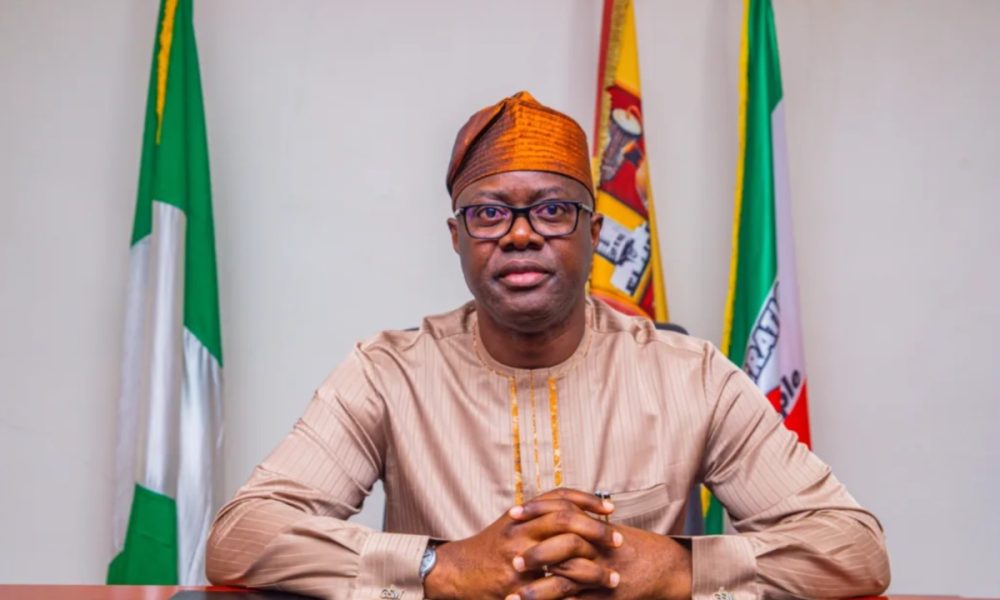
MEET YOUR CANDIDATES 2027 — Profile #4. Oluseyi Abiodun Makinde, 58, is the Allied Peoples Movement (APM) candidate in the presidential election of Saturday, 16 January 2027, with Lawal Musa Daura, a former director-general of the State Security Service, as his running mate. He is the only sitting governor on the ballot — and he got there through a two-year factional war inside the Peoples Democratic Party (PDP) that ended with rival expulsions, annulled conventions and, finally, his emergence as the consensus candidate of a much smaller party. He turns 59 on Christmas Day.
Makinde was born in Ibadan on 25 December 1967. He read electrical engineering at the University of Lagos, graduating in 1990, worked in the oil and gas industry, and in 1997 founded Makon Engineering and Technical Services — the seed of the Makon Group, an engineering and energy-services business he led as group managing director before frontline politics. He came to the governorship from the boardroom, not from government.
His road to this ballot was long. He lost an Oyo South senatorial run on the ANPP platform in 2007 and a governorship run on the SDP platform in 2015, then won the Oyo governorship on the PDP ticket in 2019 and re-election in March 2023 with 563,756 votes. Inside the PDP he rose to the inner circle: in 2023 he and Nyesom Wike were both G5 governors who defied their own party's presidential candidate. The two men later fell out over control of the party. At the elective convention Makinde's camp organised in Ibadan in November 2025, a new national working committee under Kabiru Tanimu Turaki was elected and Wike, national secretary Samuel Anyanwu, former Ekiti governor Ayodele Fayose and eight others were expelled. The Wike-aligned national executive answered by ratifying the expulsion of Makinde himself, alongside Bauchi governor Bala Mohammed, Zamfara governor Dauda Lawal, BoT chairman Adolphus Wabara, Turaki, Taofeek Arapaja and Bode George — and dissolved the Oyo state executive among others. The courts then annulled the Ibadan convention, and on 30 April 2026 the Supreme Court upheld the annulment in a split decision, faulting the Makinde-backed camp for defying subsisting court orders; the judgment made no pronouncement on the expulsions. INEC recognised the Wike-aligned leadership, which held its own convention in Abuja in March 2026.
The war of words matched the war of motions. Commissioning the Oyo PDP secretariat in Ibadan on 3 February 2026, Makinde declared: "The vagabonds in PDP; they grew up in 2015. They had their time and 10 years — a decade — they practised their 'vagabondcy' in the PDP. But they were expelled in November 2025, so no more vagabonds in PDP." He added: "I came into government in 2019, and towards 2023, I was yoked with them. But now, I've repented." Wike's camp fired back, calling him a repentant vagabond. Makinde's own account of the fallout is that it is about party discipline and upholding the PDP's rules — and, as he puts it, about the future of democracy in Nigeria.
The exit itself came by alliance. Makinde's PDP faction signed a memorandum of understanding with the APM, a party his camp says it has worked with since the 2023 elections and the 2024 Oyo local elections. On 14 May 2026 Wike dismissed the arrangement in Abuja as "political 419": "There's no alliance between PDP and Allied Peoples Movement (APM) or any other political party... INEC also knows that there's nothing called a PDP-APM alliance." He added: "What you have is Seyi Makinde joining APM to be able to actualise his presidential ambition, which is already dead on arrival." Days later, at a joint rally in Ibadan, Makinde declared his presidential ambition on the APM platform, blaming what he called a deliberate effort by the ruling APC to redirect Nigeria to a one-party state; his camp answered Wike with "let the people decide." On 30 May 2026 the APM's 36 state chairmen endorsed him as consensus candidate by voice vote, and national chairman Yusuf Dantalle presented him with the certificate of return and the party flag in Ibadan. "I stand before you today with deep humility and a profound sense of responsibility as I accept the nomination to serve as the Presidential Candidate of the Allied People's Movement for the Federal Republic of Nigeria," he said. Six Oyo members of the House of Representatives followed him into the APM days later, and in August he named Daura as his running mate.
The record: schools, clinics, roads and revenue
Education. Makinde's first act in office on 29 May 2019 was to abolish the 3,000 NAIRA levy on schoolchildren, restoring free primary and secondary education. His government puts close to 1,000 renovated classrooms across the 33 local government areas, over 60 model schools built, and more than 5,000 primary school teachers recruited through the State Universal Basic Education Board. In his budget presentation on 10 November 2026 he put the number of out-of-school children returned to classrooms at over 65,000, and education takes 190.6 billion NAIRA — 17.08 per cent — of his proposed 1.115 trillion NAIRA budget for 2027. The centrepiece education achievement is LAUTECH: in November 2020 the National Universities Commission announced the end of the troubled joint ownership of Ladoke Akintola University of Technology, with Oyo taking sole ownership of the Ogbomoso university and Osun taking the College of Health Sciences at Osogbo. The settlement ended years of funding crises; Oyo has since expanded LAUTECH into a multi-campus university, including an agriculture campus at Iseyin commissioned in 2023.
Health. The administration's "One Ward One PHC" programme set out to put a functional primary health centre in each of Oyo's 351 wards; the government puts about 300 centres upgraded and about 264 of them fully equipped. Secondary facilities, including the Adeoyo hospitals in Ibadan, have also been upgraded.
Workers and wages. In November 2024 Makinde approved an 80,000 NAIRA minimum wage for Oyo workers — above the 70,000 NAIRA federal rate — on the recommendation of a technical committee. Salaries are paid on or before the 25th of each month. On Arise News on 13 November 2026 he stated the record plainly: "We have never owed salary for one month out of the seven-plus years I have spent as governor of Oyo State."
Infrastructure and the economy. Completed roads his administration points to include the 65-kilometre Moniya–Ijaiye–Iseyin road, the 76.7-kilometre Iseyin–Fapote–Ogbomoso road and the 34.85-kilometre Oyo–Iseyin road; the first 32-kilometre section of the 110-kilometre Ibadan Circular Road has been opened, and the state information commissioner, Dotun Oyelade, puts completed roads at 465.66 kilometres with a further 533.34 kilometres under construction. In his budget presentation, Makinde put internally generated revenue at 103.25 billion NAIRA in 2025, up from 26.59 billion NAIRA in 2019 — a 288 per cent rise. In agribusiness, his account credits the Oyo State Agribusiness Development Agency, created by law in 2020, and the Fasola hub — designated by the African Development Bank as Nigeria's first agricultural transformation centre — with 16 agribusinesses, investments worth over 20 billion NAIRA, over 1,000 direct and indirect jobs and 30,130 farmers captured on its register, with a second hub started at Eruwa.
What Makinde is promising for 2027 — in his own claims
Makinde unveiled his manifesto, the "Reset Nigeria" agenda, in Abuja on 4 November 2026. At the campaign flag-off in Bauchi on 7 November he set out three resets: reset the economy, with hunger named as Nigeria's biggest challenge; reset the security architecture; and reset the socio-political system to end exclusion — including, if he wins, a government of national unity. At a South-East town hall in Enugu he pledged to tackle youth unemployment and to train one million young Nigerians in skills that can secure employment almost immediately. In Bauchi he also urged voters to accept campaign money if it is offered but vote their conscience.
His pitch for the ticket itself is data. On Arise News on 13 November 2026 he said he chose the APM platform based on data rather than emotion — the calculation of an engineer — and declared: "I will win 2027 on my Oyo record." He frames the election as "APC versus Nigerians" — at Oyo town on 14 November he put it this way: "This election is between APC and Nigerians. Nigerians will show them what they have never seen before." On alliances, he says the opposition should rally behind the candidate with the strongest prospects, judged by data, manifestos, past performance and the sentiments of Nigerians, and he confirms discussions involving Atiku Abubakar and Peter Obi are continuing. The Electoral Act deadline for candidate withdrawal passed on 18 October 2026, so any arrangement now would be cooperation between tickets that all remain on the ballot.
The other side: expulsions, debt and a party within a party
Expelled, defected — or neither? How Makinde left the PDP is itself disputed. The Wike-aligned executive ratified his expulsion; his own Oyo PDP spokesman, Michael Ogunsina, announced that "Governor Makinde is now officially a member of the APM" — an announcement the Wike-backed PDP, through its spokesman Jungudo Mohammed, disowned as misleading and unauthorised. Former PDP presidential campaign spokesman Umar Sani argues Makinde never made a categorical statement of defection at all — unlike Bala Mohammed, who formally defected — and that the party's national working committee would decide his fate. What is not in dispute is the destination: he holds the APM ticket, and INEC's final list carries his name.
Debt and the Government House. The Oyo APC, through publicity secretary Olawale Sadare, called the August 2025 approval of a 300 billion NAIRA facility "surreptitious" — passed at emergency sittings during the Assembly's recess — and assembly member Shittu Ibraheem alleged it was secured without proper legislative procedure. Former education commissioner Adeniyi Olowofela puts the administration's borrowing at over 500 billion NAIRA since 2019 and calls the habit "legendary"; he also attacked the 63.4 billion NAIRA approved in June 2025 to overhaul Government House — a sum one budget review noted exceeds the 59.4 billion NAIRA allocated to the entire health ministry that year. The government's answer on the loan is that there is no 300 billion NAIRA fresh loan: 149 billion NAIRA refinances an existing facility on better terms and 151 billion NAIRA is for infrastructure and contractor financing — "refinancing is not new borrowing." Makinde's answer on the debt figures and the Government House is the exchange rate: an inherited 200 million US dollar World Bank loan, he says, grew in naira terms from about 70 billion NAIRA to over 300 billion NAIRA as the currency fell, pushing monthly debt service from 700 million NAIRA to 3 billion NAIRA. Information commissioner Oyelade adds that Government House had become "an embarrassing and unbefitting facility," with the governor and deputy living in their private homes for six years. Olowofela counters that the previous administration accessed only a fraction of that World Bank facility, and that blaming it after six years is diversionary.
Home-front friction. The APM move was not unanimous even in Makinde's own house. His former chief of staff, Segun Ogunwuyi, was not consulted on it and has since left; a loyalist of Ogunwuyi's, Joshua Olusola Afolabi, said in November: "We simply woke up one day and were told that we were now in APM... None of us had an APM membership card, including the governor." A wave of resignations by appointees was reported around the 10 November budget presentation; Makinde responded there that the departures would not change his government's direction. On local government funds, senior advocate Mutalubi Ojo has criticised the administration's handling; APM chieftain Dare Adeleke answers that performance should be judged by what residents experience — roads, schools, clinics and salaries paid on time. Residents along the Ibadan Circular Road corridor have also protested what they call a land-grabbing scheme around the project's expansion, as reported by The Legal Observer.
A challenge inside the APM itself. In a statement reported on 16 November 2026, the APM's board of trustees rejected the leadership of national chairman Yusuf Dantalle — the man who presented Makinde's certificate of return — citing Federal High Court judgments of 20 May 2022 and 18 November 2022 which the trustees say vacated the party's executives at all levels. The trustees say they wrote to INEC in June 2026 asking it to enforce the judgments, have served contempt processes, and now disown the candidates and alliances of the disputed leadership; party chieftain Ibrahim Waziri has called the Bauchi flag-off illegal and says his lawyers are studying enforcement. No direct response from Dantalle or the Makinde campaign was on record as this profile was published, and the campaign has continued on the road without pause since the trustees first wrote to INEC. INEC's published final list — the operative document — still carries Makinde and Daura. NewsTweetNaija reports the challenge as it stands; it does not decide it.
Supporters say the Oyo record travels. Bauchi governor Bala Mohammed, the APM's national leader, says he and Makinde left the PDP over injustice, and that the proposed government of national unity would promote equity and accommodate Nigeria's diversity. Dantalle says the 36 state chairmen affirmed Makinde "due to his pedigree and known track record in Oyo State," calling the emergence the start of a "national rescue mission." The GSM Advocates movement argues the seven years in Oyo provide "a practical template that can be replicated at the national level." Critics say the ticket is built on sand: Wike calls the alliance "political 419" and the ambition "dead on arrival"; the Oyo APC questions the debt; Waziri questions the nomination's legality itself.
What happens next
Makinde's place on the ballot is settled; two files around it are not. The first is the APM trustees' enforcement push at INEC — unless the commission acts or a court orders otherwise, the ticket stands. The second is the opposition cooperation question: the six-party unity summit scheduled for 23 November in Abuja will test whether the talks he confirms produce a common front or a crowded ballot. Either way, his second term in Ibadan ends on 29 May 2027, and he has already anointed a continuity candidate at home, presenting Bimbo Adekanmbi as the APM's Oyo governorship candidate on 14 November. Election day is Saturday, 16 January 2027.
Sources: INEC final candidates list; Seyi Makinde's 2027 budget presentation (10 November 2026); National Universities Commission announcement on LAUTECH (November 2020); Oyo State Government statements via BusinessDay; VON; The Sun; Chronicle NG; NewsCentral; Peoples Daily; Premium Times reporting; Arise News interview (13 November 2026). This profile is part of NewsTweetNaija's "Meet Your Candidates 2027" series — every candidate on the INEC final list, profiled to the same standard. It will be updated as the campaign develops.
Follow @newstweetnaija on Instagram for the next profile in the series.
